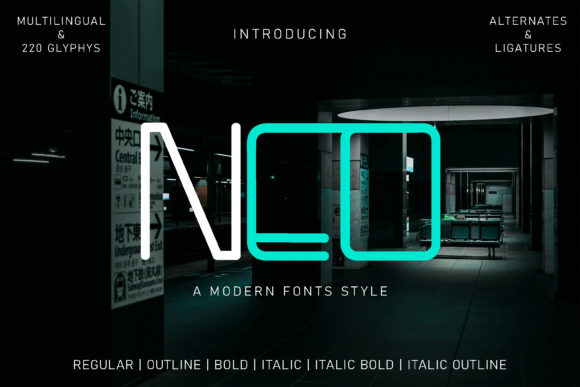
Evaluating Neo: A Minimalist Display Font for Modern Design
In the landscape of contemporary typography, the demand for clean, geometric, and futuristic typefaces continues to grow. Designers often seek fonts that convey precision and modernity without sacrificing readability or aesthetic appeal. Neo emerges as a notable option in this category, defined by its minimalist structure and flawless precise strokes. As a display font, it is engineered to command attention in headlines and short-form text while maintaining a sophisticated visual identity. Understanding the specific characteristics of Neo is essential for designers evaluating whether it aligns with their project requirements.
Defining the Aesthetic of Neo
Neo is characterized by a strict adherence to minimalism. Its design philosophy strips away unnecessary ornamentation, focusing instead on the purity of line and form. The strokes are uniform and precise, creating a sense of order and technological advancement. This makes the typeface particularly effective for projects that aim to communicate clarity, innovation, or luxury through simplicity.
Unlike serif fonts that evoke tradition or handwritten scripts that suggest personal touch, Neo occupies a space of modern neutrality. It does not impose a heavy personality on the content but rather enhances the surrounding design elements. This quality allows it to function effectively as a supporting element in complex layouts or as the primary visual hook in branding initiatives where the logo itself relies on typographic strength.
Technical Capabilities and Accessibility
Beyond its visual style, the technical construction of Neo offers significant flexibility for professional use. A key feature is its PUA (Private Use Area) encoding. For designers unfamiliar with this term, PUA encoding ensures that all glyphs, alternates, and ligatures included in the font file are accessible across different operating systems and design software without the need for special character maps or complex keystrokes.
This technical advantage streamlines the workflow. When working on intricate designs such as wedding invitations or product packaging, access to alternate characters allows for unique customization. A designer can swap standard letters for stylistic variants to create a more bespoke look without altering the fundamental geometry of the font. This level of control is crucial when balancing the need for consistency with the desire for unique visual flair.
Ideal Applications and Use Cases
The versatility of Neo makes it suitable for a wide array of applications, though it performs best in specific contexts. Its nature as a display font means it is optimized for larger sizes rather than long blocks of body text.
- Branding and Logos: The precise strokes provide a solid foundation for logo design, particularly for tech startups, architecture firms, or fashion labels seeking a sleek image.
- Wedding Invitations and Stationery: While often associated with technology, the elegance of minimalism fits modern wedding themes. Neo can be paired with delicate floral illustrations or used alone for a chic, contemporary invitation suite.
- Product Packaging and Labels: On physical goods, clarity is paramount. Neo's clean lines ensure legibility on shelves, making it effective for cosmetics, electronics, or gourmet food packaging.
- Digital Media: For social media posts, website headers, and photography watermarks, the font offers high impact at various resolutions. Its geometric forms render clearly on screens, maintaining integrity from mobile devices to large desktop monitors.
- Advertising: In print and digital advertisements, where message delivery must be instant, Neo's bold presence helps capture viewer attention quickly.
Benefits and Design Considerations
Adopting Neo offers several distinct benefits. Primarily, it provides a timeless quality. Trends in typography shift frequently, but the core principles of minimalism tend to remain relevant longer than highly stylized decorative fonts. Investing in a typeface like Neo can future-proof a brand identity or design portfolio.
Furthermore, the precision of the strokes reduces visual noise. In cluttered environments, such as busy social media feeds or crowded retail shelves, a clean font helps the message stand out by offering a moment of visual calm. The PUA encoding further adds value by expanding the creative palette available to the user, allowing for subtle distinctions that can elevate a standard layout into a custom design.
However, there are tradeoffs to consider. As a display font, Neo is not intended for extended reading. Using it for paragraphs of text in a brochure or a long-form article would likely result in reader fatigue due to the lack of serifs and the uniform stroke weight, which can reduce distinction between characters at small sizes. Designers must pair Neo with a complementary sans-serif or serif font for body copy to ensure optimal readability.
When to Consider Alternatives
While Neo is a powerful tool, it is not a universal solution. Evaluators should consider alternatives if their project demands a specific emotional tone that minimalism cannot convey. For instance, if the goal is to evoke warmth, nostalgia, or organic growth, a humanist sans-serif or a soft serif might be more appropriate. Neo's futuristic and precise nature can sometimes feel cold or distant if not balanced with warm imagery or color palettes.
Additonally, if a project requires high levels of accessibility for audiences with visual impairments, fonts with higher x-heights and more distinct character shapes might be preferable for certain applications. While Neo is clear, its minimalist approach can occasionally blur the distinction between similar characters (such as 'I', 'l', and '1') depending on the specific weight and rendering environment.
Making the Decision
Selecting a typeface is a strategic decision that impacts the overall success of a design project. When evaluating Neo, the primary question should be whether the project benefits from a modern, futuristic, and minimalist aesthetic. If the objective is to communicate efficiency, luxury, or forward-thinking innovation, Neo is a strong candidate.
Designers should also assess the technical requirements of their workflow. The inclusion of PUA encoding is a significant practical benefit for those who rely on extensive glyph variations. However, one must remain mindful of the font's limitations regarding body text. A successful implementation often involves using Neo for headings, logos, and accent text while relying on a more readable counterpart for detailed information.
Ultimately, Neo represents a refined choice for those who value precision and understated elegance. It serves as a versatile asset in a designer's toolkit, capable of enhancing everything from a simple greeting card to a comprehensive corporate identity system. By understanding its strengths and respecting its limitations as a display typeface, creatives can leverage Neo to produce work that is both visually striking and functionally effective.